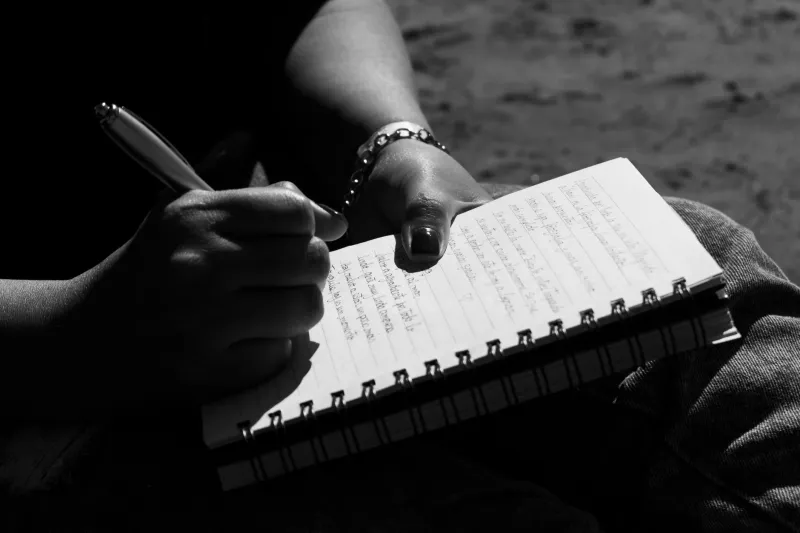
What Nobody Sees Is What Actually Builds You

There's a version of creative success that looks great on a grid. Clean aesthetic. Consistent output. Engagement numbers that make other people feel behind. And then there's the actual work — the stuff that happens in the hours before that post goes up, and in the years before anyone cared enough to click.
Here's the thing nobody tells you early enough: the invisible work is doing more for your career than the visible output ever will.
The Real Resume Lives Offline
Every creator has two portfolios. One is the public-facing highlight reel — the projects that landed, the collaborations that got press, the pieces that performed. The other is the one nobody posts about: the pitch that got rejected but taught you how to read a room, the experiment that flopped but cracked open a new way of thinking, the conversation with a peer where you were honest about what wasn't working instead of performing confidence.
That second portfolio? That's the one people in position to actually change your trajectory are reading.
When a director, editor, agency, or collaborator is trying to figure out whether to take a chance on someone, they're not just Googling your work. They're asking around. They're listening for how you talk about other people's projects. They're noticing whether you give credit, whether you follow through on small things, whether your standards hold even when nobody's watching.
Reputation in creative industries is almost entirely word-of-mouth, and most of that word-of-mouth is about the version of you that never appears in a caption.
Integrity Is a Practice, Not a Personality Trait
A lot of creators treat integrity like it's something you either have or you don't — like it's baked into your character and you're off the hook after that. But integrity in creative work is actually a daily practice. It's the decision to do the extra revision when you could have shipped something good enough. It's the email you send acknowledging that a project didn't land the way you promised it would. It's the moment you don't take credit for an idea that wasn't entirely yours.
None of that shows up in your analytics. All of it shows up in how people describe you when your name comes up in a meeting you're not in.
The creative professionals who build real longevity — not just a moment, but an actual career — tend to have a specific quality that's hard to name but easy to feel. They're the same person in the pitch meeting as they are in the post-mortem. Their private standards match their public presentation. You don't get the sense that they're performing a version of themselves. And that consistency, over time, becomes magnetic.
The Hidden Cost of Playing a Character
Social media has made it incredibly easy to curate a persona. You can engineer the narrative of your creative journey — which struggles you highlight, which wins you amplify, what version of your process you let people see. And to be clear, curation isn't the same as dishonesty. Choosing what to share is just editorial judgment.
But there's a line. And a lot of creators cross it without realizing it.
When the character you're playing starts to drift too far from the person doing the actual work, something breaks down — not publicly, not all at once, but in the small moments that matter. The collaborator who worked closely with you notices the gap. The mentor who introduced you to an opportunity hears back that you weren't what they expected. The audience that bought into a version of you starts to feel something's off, even if they can't articulate why.
People are better at detecting inauthenticity than we give them credit for. Not always consciously, but they feel it. And when they feel it, they stop advocating for you — even if they can't explain exactly why.
What You Do With the Failures Matters More Than the Failures
Every creative person has work that didn't go the way they wanted. Projects that missed. Pitches that got passed on. Collaborations that quietly fell apart. The failures themselves aren't what define you. What defines you is what you do with them when nobody's watching.
Do you get honest about what went wrong, or do you craft a story that protects your ego? Do you go back and study the failure, or do you move on fast enough that you don't have to feel it? Do you reach out to the people involved and close the loop with integrity, or do you let it fade into the background of your timeline?
The answers to those questions are building something. They're building the version of you that exists in other people's minds — the version that either gets recommended or doesn't, that gets the call or doesn't, that gets trusted with bigger opportunities or stays stuck at the same level.
The People Who Matter Can Tell
Here's what I've noticed: the people who are actually positioned to open meaningful doors for you are almost always the ones who've been around long enough to know the difference between someone doing the real work and someone doing a convincing impression of it.
They've seen the whole arc. They've watched creators burn bright and disappear. They've worked with people who looked great on paper and were chaos in practice. They've also worked with people who were quieter, less flashy, slower to accumulate followers — and those are the people they keep calling back.
Your off-camera work is a signal. The way you handle the hard conversations, the care you bring to things nobody asked you to care about, the standards you keep when there's no applause for keeping them — all of it is readable to the people who know what to look for.
The public output gets you noticed. The private work gets you trusted. And in the long run, trust is the only currency that actually compounds.
Start Where You Are
You don't need to overhaul anything. You don't need a new strategy or a better content calendar. You just need to ask yourself one honest question: is the work I'm doing in private — the thinking, the revising, the way I treat collaborators, the standards I hold when no one's looking — is that work something I'd be proud of if it were suddenly visible?
If the answer is yes, keep going. You're building something real.
If the answer is no, that's actually useful information. Because the gap between who you are off-camera and who you're presenting on-camera is exactly where your next level of growth is hiding.